UNO Media Carrier
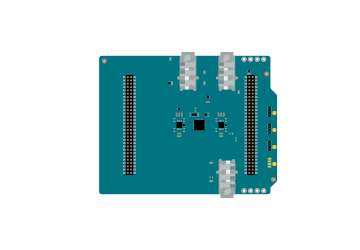
The UNO Media Carrier extends the multimedia capabilities of compatible boards, enabling advanced vision, display, and audio applications with plug-and-play simplicity. It connects via the JMEDIA and JMISC high-speed connectors, providing access to dual MIPI-CSI camera interfaces, a MIPI-DSI display interface, and three 3.5 mm audio jacks, all in the UNO form factor.
Downloadable resources
The UNO Media Carrier is a carrier board that provides access to camera, display, and audio interfaces through the JMEDIA and JMISC high-speed connectors. It exposes two MIPI-CSI camera inputs, one MIPI-DSI display output, and three 3.5 mm audio jacks. Both connectors use a passthrough design, so all signals remain available for additional modules or expansion.

Dual MIPI-CSI Camera Connectors
The UNO Media Carrier provides two 22-pin MIPI-CSI connectors compatible with IMX219 cameras (e.g. Raspberry Pi Camera Module 2), enabling dual-camera computer vision applications such as stereo depth mapping, multi-angle capture, and object tracking.

MIPI-DSI Display Connector
The UNO Media Carrier provides a 22-pin MIPI-DSI connector compatible with specific Waveshare displays out of the box, making it easy to add interactive visual output to your projects.

Multi-Channel Audio
Three dedicated 3.5 mm audio jacks offer flexible audio input and output: one combined microphone input and headphone output, one line out for amplifiers or powered speakers, and one ear out for direct earphone connection.

Passthrough Connector Design
Both the JMEDIA and JMISC connectors feature a passthrough design, allowing all host board signals to remain accessible for stacking additional modules or carriers in your setup.

UNO Form Factor
The UNO Media Carrier follows the UNO form factor designed to stack directly onto compatible host boards, such as UNO Q, through the JMEDIA and JMISC connectors for a compact, integrated solution.

Expanded Interfaces
Through the JMEDIA and JMISC connectors, the UNO Media Carrier also exposes I2C (CCI and MCU I2C4), PSSI parallel camera interface, SoC GPIO (1.8 V), and MCU GPIO (3.3 V) for further peripheral integration.