Nano XL Link
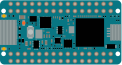
The Nano XL Link is a compact board for industrial and building automation, based on the Microchip® PIC32CK2051SG01144 microcontroller (Arm® Cortex®-M33). Its onboard CAN FD, RS-485, and Ethernet interfaces connect it to industrial networks, and its extended Nano pinout adds a second row of headers with additional I/O and fieldbus lines.
Downloadable resources
The Nano XL Link is based on the Microchip® PIC32CK2051SG01144 microcontroller, a 32-bit Arm® Cortex®-M33 with 2 MB of flash memory, 512 kB of RAM and an integrated hardware security module (HSM). The board is programmed with the Arduino Zephyr core, which runs Arduino sketches on top of the Zephyr® real-time operating system.
The board integrates CAN FD, RS-485 and 10/100 Ethernet interfaces and extends the classic Nano pinout through two 2x15 headers, so it can connect directly to industrial networks.

The PIC32CK2051SG01144 provides 2 MB of flash memory, 512 kB of RAM and a hardware security module (HSM) for secure boot and key storage.

An onboard TCAN3414 transceiver exposes the CANH and CANL lines on the headers. Supports classic CAN and CAN FD with payloads of up to 64 bytes and data rates of up to 8 Mbps.

An onboard THVD2410 half-duplex transceiver exposes the A and B lines on the headers, with support for the ArduinoRS485 library and Modbus RTU applications.

An onboard KSZ8081RNAIA PHY provides a 10/100 Mbps Ethernet interface through the Zephyr network stack (IPv4, TCP, UDP, DHCP and DNS). The RJ45 connector and magnetics are provided by the Nano Connector Carrier.

Two 2x15 headers keep the classic Nano digital, analog and power pins and add a second row with 12 extra digital pins, a second SPI bus, an I²C bus, a second UART, I²S and the fieldbus lines.

The onboard Qwiic connector provides a +3.3 VDC I²C bus with pull-up resistors for Qwiic, STEMMA QT and Modulino® devices, without soldering.

The board can be powered from USB-C, from +7-24 VDC on the VIN pin through the onboard buck converter, or from a regulated +3.3 VDC source on the 3V3 pin.

Rated for operation from -20 °C to +85 °C, with bus termination resistors for CAN and RS-485 selectable through onboard solder jumpers.